
On Suffering and Growth
Do not fall in love with your suffering

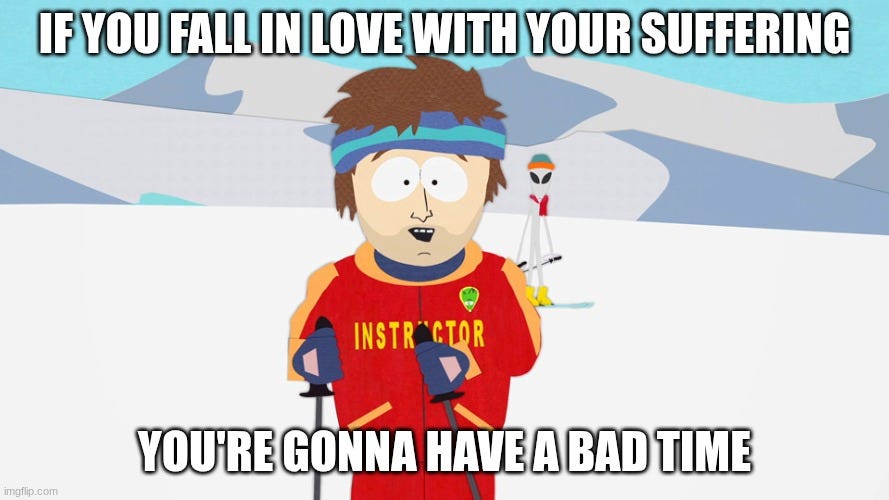
It is true that suffering, in a wide sense of the word, is a source of growth. We must experience the world, undergo life, bear new weights to gain new strengths. There are healthy kinds of suffering.
But for some people, suffering can become an unhealthy habit— an addiction.
This can happen to anyone, so I’m here to warn you.
It often happens to those who, at some point early on, had no choice— suffering was given to them. Fate threw them into a difficult situation, and they had to endure it; maybe frequently, maybe for a long time. They were forced to learn to grow from it, to turn it into something valuable. Quite naturally, they learned an unhealthy comfort in it, developing a dangerous yet all-too-human identification with their pain. They learned to love their suffering, to protect their pain like a secret, precious jewel.
To survive great suffering, humans must make meaning of it. They must, because the alternative is death, and death is not an abstraction. Death ends suffering; to choose life requires that we tell ourselves a story in which suffering is meaningful.
However, that does not mean we need to extend our suffering, or continually inhabit it, or carry it beyond necessity— though we often do, as creatures of habit. What was once a necessary survival mechanism can become, in a different environment, something that causes us unnecessary harm. But if we become conscious of these bad habits, perhaps we can change them.
The true danger lies in a too-close association between suffering and growth, suffering and love, suffering and identity, suffering and greatness, suffering and meaning. Suffering in itself is not a perfect proxy for growth— some suffering is excessive; some suffering is completely useless; some suffering can inhibit, rather than inspire, further growth. This pernicious identification of greatness with suffering can often lie so deeply in the psyche that it becomes invisible; the ‘martyr complex’ known to psychologists is one example of this identification becoming pathological.
If you subconsciously substitute suffering for growth/greatness/meaning/love/etc., it can lead you to subconsciously seek suffering. Parts of yourself may engage in destructive self-sabotage, without you even realizing it’s happening. This can foster an unconscious war within yourself, one that will never find peace unless you become aware of its source, and work to root it out.
Thus it is important for us all to look deeply into our own hearts, to look under the rug and behind every cupboard of the soul to see if we’ve been using suffering as a proxy for growth. Suffering can lead to good things, but it is not itself good. We must inevitably accept some suffering, but we should not suffer more than is good. What is good? That’s up to us.
Because there’s not a 1:1 correlation between suffering and growth, there must exist a spectrum of the value of suffering, from good to bad— from “worth it,” maximally, to worthless. Yet, as I said, we humans must make some meaning out of our past suffering— must make the most of it, and learn everything it can teach, until one day we can hopefully let go of the suffering while keeping the growth. Thus, we might be in a position where we have to amor fati all past suffering as “good,” while also opening ourselves to the potential future in such a way that both minimizes worthless suffering and maximizes valuable suffering— suffering that provides growth, learning, contact, whatever we value as good moving forward.
We must fully accept the past, yet still stand some small resistance against will-lessly accepting the future.
To avoid suffering, one should be very careful about choosing a spouse. Most important decision one will likely make.