
The Sequoias Speak
My favorite poem of 2022

My time in the sequoias in 2022 taught me how to truly listen to nature, listen in the deep way that lets you translate a place into poetry. This poem was the jewel of my time there. Back then, I considered this long poem— broken into sections written at different moments during my week in the seemingly silent sequoias— to be my best poem yet. Ah, to be young! Now, as my poetry has improved over the years, I feel some slight embarrassment at sharing it. But only slight. It was written at the same time as Sequoia Poems (2022) and For Mary Oliver. After posting Sequoia Poems (2026), this is the finale of what’s become a cool April Sequoia Series.
The Sequoias Speak is heavily influenced by T.S. Eliot’s masterpiece, The Four Quartets, four elemental meditations on time and timelessness— especially the final quartet, Little Gidding, focused on fire. Eliot, to me, is the antithesis to Walt Whitman, who represents America’s poetic thesis. Eliot is the Anakin Skywalker of American poetry, the 20th century genius who could have been the successor to Whitman’s aspirational 19th century prophecies. “You were the chosen one, Anakin! You were supposed to bring balance to the force, not leave it in darkness!” Eliot was born at the crux of America in St. Louis; but he chose to go east, to England, rather than to the west still awaiting its worthy poet. If he’d gone west, The Waste-Land would have been very different, since there IS water under the shadow of the red rock, as anyone who’s visited Zion National Park knows. But alas. England. The past. The ungraspable moment of the rose.
This poem is representative of one of my larger projects as an American poet— to synthesize the dialectic between Whitman and Eliot, who denied his own reactionary relationship to Whitman’s inescapable influence. I have Whitmanic values but tighter Eliotic line lengths; Whitmanic philosophy put through Eliot’s philosophical rigor; unlike Whitman, but like Eliot, I am in touch with darkness and failure and pain; unlike Eliot, but like Whitman, I refuse to linger on this, choosing to lean into optimism and hope, finding positive self-stories worth acting on with the Will to Believe of William James and American Pragmatism. I am not an ironic or critical poet; I cannot help but end my poems on a hopeful note. This poem ends in a way that parallels Little Gidding— this time not with Eliot’s pure being, but with nature’s burning becoming.
Perhaps to deeply feel the dark depths of ourselves can allow our chosen light to burn brighter; perhaps America needs this, too, facing our failures while embracing possibility despite it all— for example, in the 21st century, we can face the devastating reality of our near-complete continental ecocide, while still cherishing the massive future held in every sequoia seed. Cornel West argues in many of his books that American writing draws on a ‘jazzy’ Emersonian thread of potential and a ‘bluesy’ Melvillean thread that interrogates our monstrous crimes and failures; the best American writers, like James Baldwin, carry them both together in creative tension.
The Sequoias Speak


I

The sequoias speak in tongues of flame.

The sequoias speech is burning.

The sequoias speak in the space above fire.
The sequoias speak slightly spirally straight skyward,
coils of living smoke, softly made hard.


II

Years ago I lost the notebook that grew my first sequoia poems—
And how many sequoia conelings fall to the earth to linger,
And how few sequoia seedlings land in the ideal spot to sprout,
How few possibilities find footholds on the fortunate path,
Stay still at the nexus of necessity, the perfect storm
Growing in the center of the inward flowing
Of water and fire, earth and the girth of wide air,
Light, and what is living
(The same sequoiac alchemy, calculable,
The same elemental speaking of slightly special centers)
And the space taken for growth, and the time desired for growth,
And what is orthogonal to space and time
Like a sequoia sticking off the side of a mountain,
And the balance of dying
And moving forward.


III

The sequoias need not speak,
For the space they create supports many speakers.
The squirrels and birds and myself speak
In dialogue with the silence of the sequoias
And volunteer chatter on their behalf.

What is to represent but to touch and be touched?
And what is representation but living together?

Of course, the sequoias do not need us to speak for them.
They speak very well for themselves
In the language older than words,
A language clear as the contours of bark.

They each stand on their own soapbox,
Voting as one and as one.


IV

The screeching blue birds and I are translators
At the feet of larger prophets whose words will outlive us.
This chat matters more to me than to this sequoia.
It permits me attendance, but will not speak over its usual
Slow whisper to the birds.

I must admit a bias to my species,
And a bias to our language, less simple, less strong,
But significantly more imaginative than any I’ve heard.

I came here to hear the poetry of the great trees,
To translate for my peers what my ear cupped to bark sees,
To give a Whitmanic tongue to nature’s largest phallus.


V

The sequoia speaks as many tongues as there are
Listeners in the forest,
And what I receive is only what I imagine
It could want to share with me,
What could be meaningful to carry to my tribe.

What is born between my mouth and the sequoia’s silence
Is poetry.

What is born between the sequoia’s mouth and my silence—
Could it not already be poetry?


VI

General Sherman says
The name you call me is not my name.
You could not speak my name except in long silence.

The sequoia says I am not your backdrop,
I am not owned by this flat image of yourself,
Unless you are open to listening at my pace.

I do not want you to wrap me in fire-resistant foil.
The fire is my destiny and it will take me in my time.
I have seen it take many larger.
I am not your child, I do not need protection.
You are the children, you need my protection.
If only you knew of the fires to come.

I sit with my neck craned back for a long time
As tourists come and go, capturing
And commodifying something they do not understand,
Briefly, like an assembly line, before leaving
Without the sequoia finishing a single word.

The sign says do not cross the fence,
And I do not listen,
For the tree has a higher authority.
When no one is looking I hop the fence
From behind, hidden from tourists by the tree.
I run to it, breathless, and wrap my arms around it.
I hug the tree as long as I can.

I think it says
Thank you.
So many have come and so few have listened,
Have touched, have shared without taking,
Without stealing my image for themselves.
Here, a tiny red penny wedged in my red wideness.
My bark has nearly grown around it,
But I do not want this meaningless metal in my body.

I remove the wound.
No one has seen it since 1972.
We thank each other with our true names,
Wordless.


VII

The sequoias say
Fire chose me to live
My place hand-selected by the lives of the dying.

The patches brown and groves gone scare me not.
My birth meant ashes were my blessed lot—
I will survive all my burnings,
My scar tissue the Garden.


VIII

I say to the sequoias
Look— I want them to see this sunset
And though they do not look like me
I know they feel the beauty coloring
The sun’s dying of the day.


IX

The logged sequoias say
What does absence convey?
And how does fire fill emptiness?


X

The sequoias say
Our seeds require fire to break open.
I say
I hope the seeds of the New World are the same way.


XI

I ask the sequoias where souls go after burning.
The sequoias say we live beyond death
In sprouts.

We say we have long suspected dying young.
We hope by then to have scattered enough seeds
To sprout in the soil of those we love,
To grow great beyond this body.


XII

I ask this sequoia, more than two millennia old,
Of Christ, and the Second Coming, and if it is soon.

The sequoia laughs.
He has resurrected many hundreds of times.
He waits for us to notice salvation,
Every seed strong enough to roll the stone.


XIII

The sequoia says
I am the seed of all to come,
I am the fruit of all that was.
I am the sprouting anew of an old voice.
I am the sapling rooting for this world.

I am the young sequoia, equal to your height,
Like you striding to all the largeness of our futures
With the strength to bear the weight
Of both the old world and the new,
To carry the future as a generation uplifting
From the fuel of the past, the soil, the ash.
The victory of the young is not guaranteed,
But prophesied, believed before true again and again,
The miracle of a people reborn.

I am the old sequoia, I am thick with experience.
I am proof of the grandness of life.
I am the sum of all knowledge.
I am potential realized, I am growing still,
Still a pyrophyte I pray for fire—
I wish for nothing more than again to be a seed
Bursting open in the heat of my demise,
Spreading in the space of my wide soot.


XIV

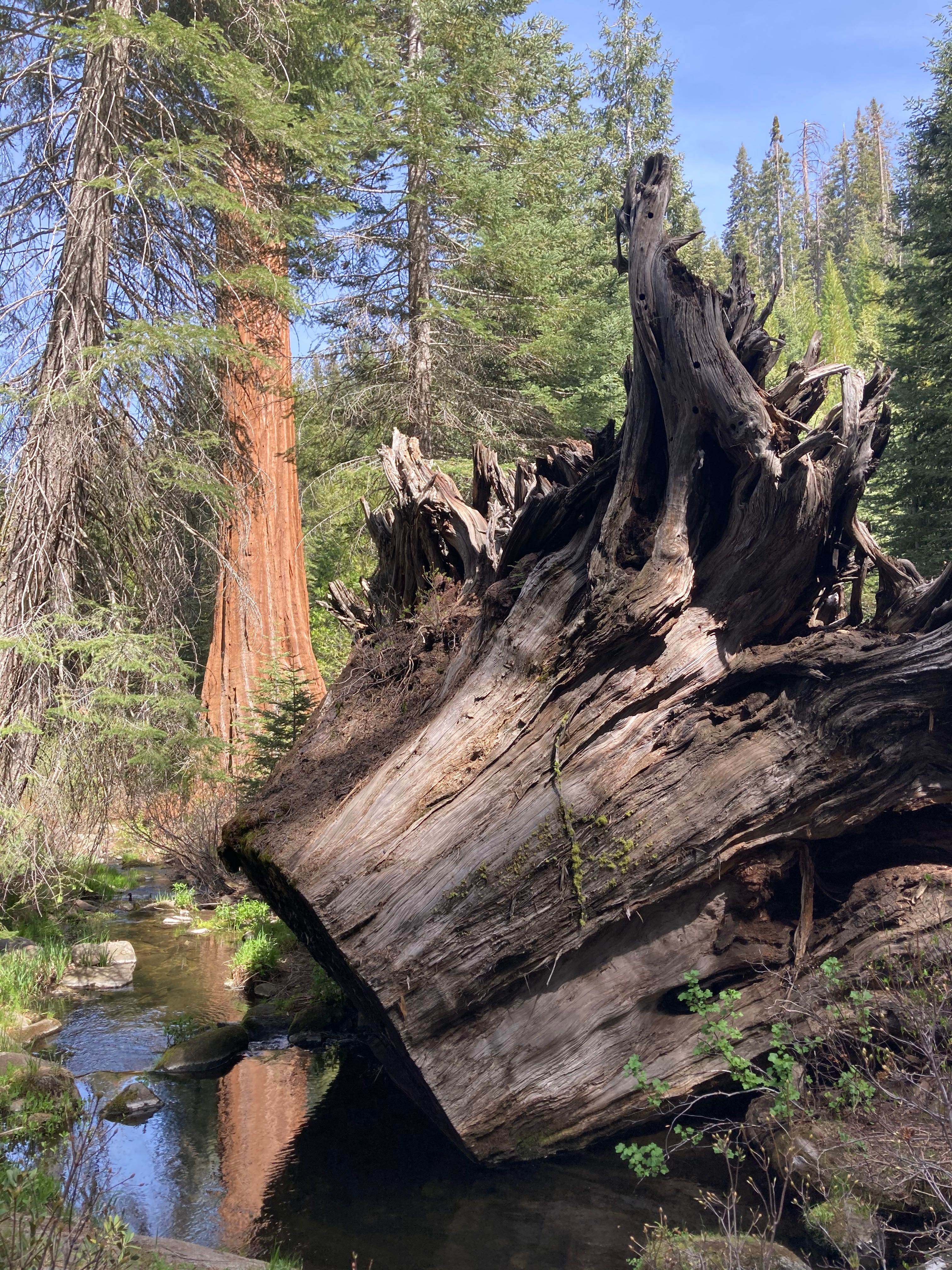
There is an old stump, massive and cut, toppled sideways,
Hanging its clean edge over the small stream’s babbling.
It shades the fish and the blue heron and I,
Having made my home for a silent week under the shadow
Of this dead sequoia’s son, 2000 years old, still living
Twenty yards away, having sprouted where his dad’s old branches,
Once the widest in this part of the forest,
Must have long ago dropped the future enclosed.

I wonder to myself, at home in the silence of time’s streaming,
Whether this dead giant can speak.

Yes,
I hear,
Loud and undeniable, awake and dreaming,
A ghost possessing me, speaking through me,
In my own voice, and I know
That the dead do speak,
That the dead speak through me,
That the dead speak through all the living
Willing to listen.

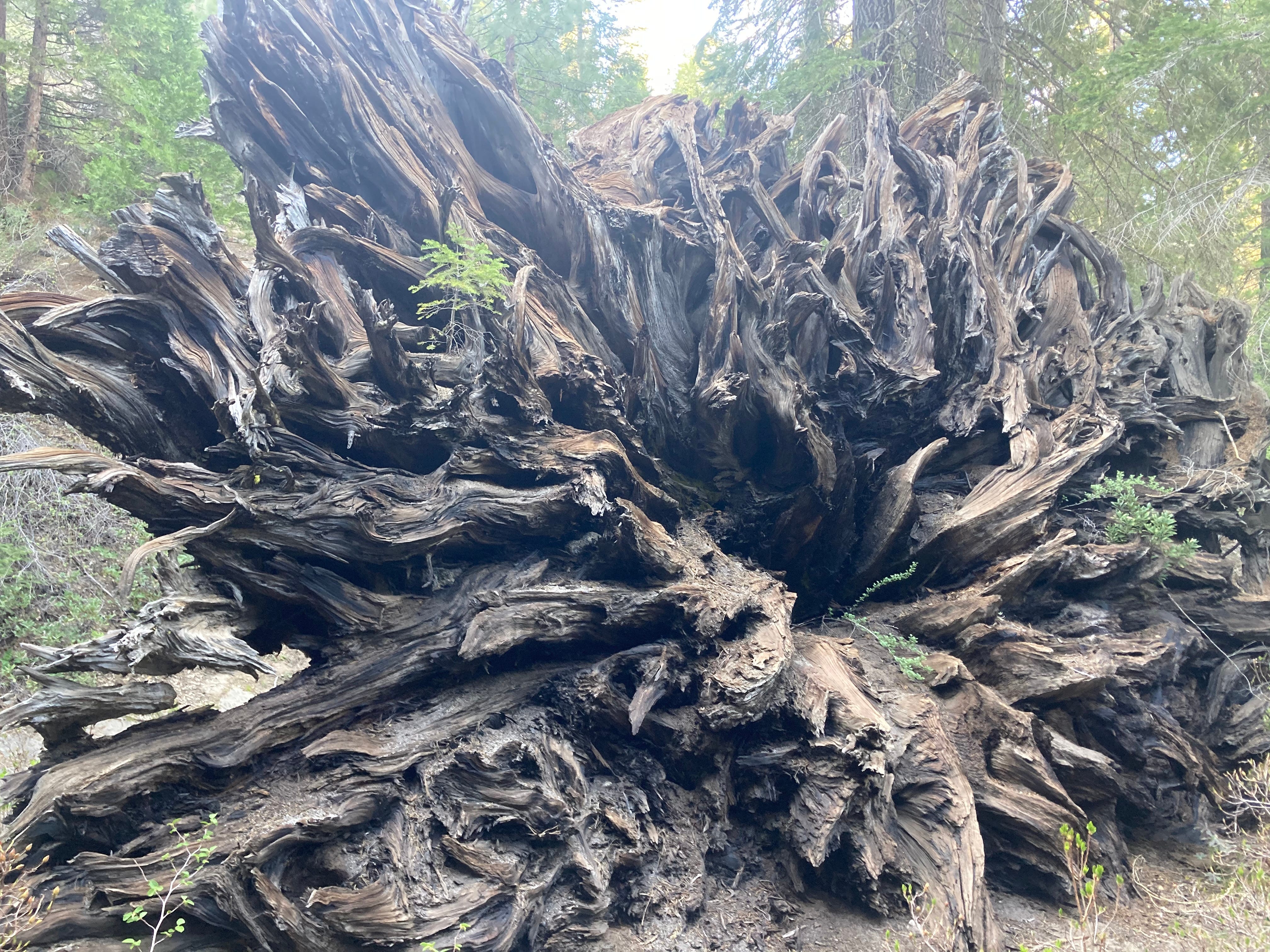
I explore behind the fallen stump
Where its massive old roots are now revealed,
Now stick upward like branches in the new air,
Twisting as if reaching for soil in the sky,
Petrified for how many years, the sequoias
Resistant to bugs, burning, and decay even in death,
The massive underground secret of the sequoia’s greatness,
The wide rooting responsible for all upwardness,
Rarely exposed for someone living to learn from.
Only the momentous falling of a massive sequoia could be
Strong enough to raise these roots to the light.

I now see that these tangled reddish roots
Are petrified fire, fire frozen for now,
And that all matter is merely fire moving slowly,
Fire coalesced, staying still and assuming form for reasons
I’ll never know. But I know that fire
Is the root of the sequoia,
That the dead return and bring us with them,
That the tongues of flame are already in-folded
Into the crowned knot of fire,
And the fire and the sequoia are one.
Wonderful intro about great American born writers. Epic poem.